

“What once made us feel outside the circle can become the very gift that helps us widen it.”
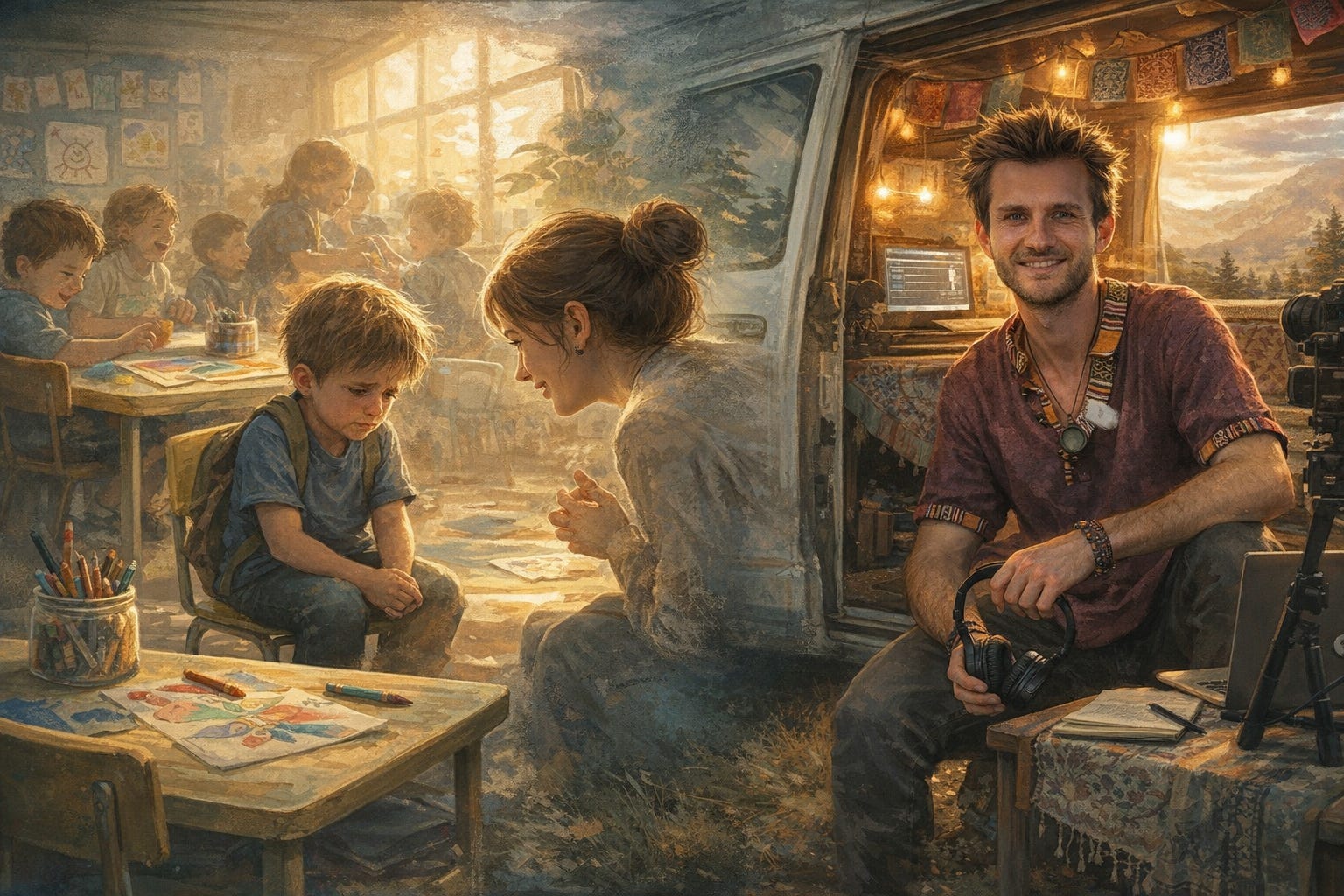
Artem was five years old, standing in a classroom full of noise he could not understand. The other children were laughing, talking over one another, trading crayons, showing each other their drawings, small hands busy with glue sticks and construction paper. The teacher knelt down, smiling, saying soothing untranslatable words. He wasn’t comforted because he didn’t know a single one of them. His parents had been too busy working and surviving to teach him English. So he cried. Not the loud, tantrum kind. The silent, chest-tight kind. The kind where your whole body knows you don’t belong.
That boy would grow up to help thousands of people feel like they do.
Fifty Dollars and a Better Life
He was born in the Soviet Union, just before it dissolved into chaos, hyperinflation, instability, and uncertainty. His parents left with two children, a grandmother, and fifty dollars. Fifty. They weren’t chasing luxury. They were chasing safety. A future without forced military service. A place where their sons could choose their own lives.
In North Carolina, they packed five people into a small two-bedroom apartment. Sometimes more. Uncles slept on couches while parents worked nonstop. His mother babysat. His father did construction. Childhood for him wasn’t structured. It was movement, noise, survival, and the quiet understanding that his parents were gone because they loved him.
He grew up between worlds.
Russian cartoons at home. American culture at school. Words he didn’t know. References he didn’t get. He learned to observe. To listen. To feel the room before speaking. To be slightly outside, even when inside. That “outsider” feeling? It would become one of his greatest gifts.
The Dreamy Kid
Artem describes himself as a “dreamy kid”. Physically present. Mentally somewhere else.
Teachers probably called it distraction. He experienced it as distance, like life was happening one layer away. Sports helped. Music helped more. The piano made sense. Sound made sense. Emotion translated there. Eventually, he followed that thread into music technology, audio engineering, and production. It was the invisible architecture behind stories and feeling.
But presence? True presence? That didn’t come until much later.
The Night the Houses Came Alive
He didn’t start as the psychedelic guy.
In fact, in college he found people’s acid stories unbearable. “Bro, I can’t hear one more trip story,” he’d tell friends.
Then one night at 23, a basketball game, a “gentle” tab from a guy on his street, and suddenly the houses were breathing. Windows had souls. The world was not solid, it was alive. He walked around gaping at his surroundings for eight hours as reality rearranged itself. He woke up the next morning feeling like someone had quietly moved the furniture of his mind while he slept.
That experience didn’t turn him into a party psychonaut.
It did something deeper.
For the first time, he felt in his body. In the moment. The dreamy distance softened. The world wasn’t happening “over there” anymore, it was happening here. Psychedelics became less about spectacle and more about exploration, nervous system awareness, and coming home to himself. Mushrooms, especially, felt like teachers organic, grounding, clarifying.
Years later, when autoimmune symptoms showed up as psoriasis, stress, imbalance — he began connecting dots: thought patterns, nervous system dysregulation, embodiment, healing. Psychedelics weren’t magic pills. They were mirrors and doorways. Yet somehow, through all of it, he told his grandmother everything.
The same grandmother who survived Stalin. World War II. Migration. She listened, horrified and fascinated, as her grandson described mushroom journeys and spiritual revelations. Love that deep makes room for strange things.
The Coffee Shop
Years later, Artem stepped away from the music industry and was living between states, cooking out of his Subaru Outback with a platform bed in the back, searching for what mattered next.
He was working from a coffee shop in Flagstaff, headphones on, laptop open, quietly building someone else’s brand.
And then, a loud and passionate a voice talking about ice baths and psychedelics like it was normal dinner conversation. He took off his headphones. I was trying to whisper ad I was blatantly failing.
That’s where we met. Here’s the strange part, some people enter your life slowly. Others feel like they’ve been walking beside you long before you knew their name. That was Artem.
We didn’t “network.” We recognized.
Our conversations didn’t feel like introductions. They felt like continuations. We spoke the same language of curiosity, meaning, impact. Where I move fast and loud, he listens deeply and builds structure. Where I see the vision, he knows how to bring it into form. We don’t overlap; we interlock.
We laugh constantly. We challenge each other without ego. We can take an idea apart without breaking trust. There’s a safety there that makes creativity fearless.
I hired him for a project. What I didn’t know was that I had just found a co-architect for a movement.
The RV and the Beginning
Years later, when I called him with the wild idea to rent an RV, travel the country, and film a boots-on-the-ground documentary of the Decriminalize Nature movement and its activists, he didn’t flinch.
“If you get the van,” he said, “I’ll come.”
Two weeks later, I had the RV. Six weeks later, we were on the road.
We drove 5,000 miles on a schedule so intense we still laugh about it. Port Townsend psychedelic society meetings with eight committees and strangers openly talking about entheogens in public. Arcata activists in the redwoods. Dana Larsen selling plant medicines over the counter in Vancouver while others canceled interviews out of fear.
What I remember most isn’t the miles.
It’s the space inside the RV between interviews, the way we could debrief for hours, unpack what we heard, feel the weight and beauty of people’s healing stories together. No competition. No ego. Just shared responsibility for the stories we were holding.
By day three, we looked at each other and said, “These stories are going to save lives.” That was the moment the documentary dream shifted. We weren’t just filming a movement. We were being asked to serve one.
Normalize Psychedelics was born there, not just from a vision, but from trust. From a partnership built on laughter, honesty, and the kind of creative alignment that feels less like work and more like purpose remembering itself.
The Man Behind the Stories
If you’ve watched the interviews, the sound that makes you lean in, the pacing, the feeling that someone is really being held while they speak, that’s Artem.
The once-silent boy who couldn’t speak the language grew up to build spaces where others can speak their truth.
He organizes the Living Library. Categories for PTSD, veterans, autoimmune healing, relationships, spiritual leaders, not just stories, but blueprints. He sees psychedelics not just as healing tools, but as intersections: health, community, inequality, nervous system regulation, connection.
He didn’t come into this as an activist, he came in as a listener, and sometimes that’s exactly who a movement needs.
Emotional Echo
There’s something poetic about a little boy in a classroom, crying because he couldn’t understand the language… grows into a man helping the world understand a language it forgot, the language of story, of vulnerability, of the healing that doesn’t come in a prescription bottle. Maybe that’s how life works. The places where we once felt voiceless become the place we help others speak their truth.
And somewhere, I know his grandmother is still listening, equal parts love and proud, as his voice, and the voices he lifts, ripple farther than that little apartment ever could have imagined.